Ultrafast photonics for next-generation compute
LightScale Photonics builds ultrafast photonic switching for AI interconnects: faster optical switching, lower communication power, and adaptive network fabrics for the next generation of compute.
AI infrastructure is hitting a communications wall
The bottleneck
Compute scaled. The network didn't. As clusters grow, moving data — not raw FLOPs — is what holds them back. Every electronic hop converts light to electrons and back again, paying for it in power, latency, and cost per bit. At a hundred thousand GPUs, the network alone runs to tens of megawatts.
What has to change
A faster version of the same thing won't close the gap. The interconnect has to move more data per joule and reshape itself as quickly as the workload does. Optical switching already shows the energy savings are real; what's missing is the speed to use it inside a running job.
Built for high-speed, low-energy switching
Our platform targets switching speed, energy, and footprint in regimes that conventional approaches struggle to reach.
Ultrafast switching
Push optical switching into a faster operating regime than conventional platforms allow.
No moving parts
A field reroutes the light, not a mirror, a heater, or an injected carrier. Solid-state photonic switching with nothing to wear, warm, or wobble.
Lower switching energy
Energy stored, not burned. Target per-switch energy roughly 1,000× lower than current silicon photonic switches, by replacing heat-driven control with non-thermal switching.
Designed for AI training and inference
AI collectives — all-reduce, all-to-all, MoE routing, bandwidth-heavy inference — want the fabric to reshape on µs-to-ns timescales, inside a single operation. Today's interconnects can't go there. Ours is built for it.
A programmable photonic network layer
The long-term goal is topology on demand: a software-defined photonic fabric that can reconfigure at packet cadence, respond to congestion and link health, and match connectivity to the workload in real time.
AI interconnects first. Broader photonics next
AI infrastructure is the first market. That's where this platform creates the clearest near-term advantage.
Over time, the same platform extends into adjacent domains including photonic compute primitives and quantum photonics.
Introducing Scale1
Our first photonic network switch
Scale1 is LightScale's first photonic network switch, built to turn the platform into a concrete interconnect product for AI infrastructure.
It is the first switch built for Hyperlane, our topology-on-demand network architecture, with a focus on faster data movement, lower communication overhead, and more adaptive connectivity across bandwidth-heavy workloads.
Latency reduction
The switching path is designed to reconfigure at packet cadence, fast enough to change topology within a collective operation, not just between runs. The goal is to make connectivity changes cheap enough to use inside the data path, not as a slow control-plane action layered on top of it.
Hyperlane — topology on demand
Topology, routing, and link assignment are exposed to the control plane. Operators can match fabric shape to workload patterns (training, inference serving, MoE routing) and feed congestion and link-health signals back into reconfiguration decisions in real time.
Non-thermal switching
Scale1 uses a non-thermal photonic switching matrix, integrated at the device level rather than assembled from discrete optical components. It is designed to scale switch radix without the thermal load or per-port power overhead of conventional reconfigurable optics.
In development: Photon1
A photonic compute chip
Designed for AI training and inference with efficiency at scale.
Photon1 targets matrix math in the optical domain — unitary operations performed by interference, with all-optical activation, so the inner loop never leaves the photonic domain.
Built on the same platform as Scale1, and programmed through the same LUMA software stack.
Rack-scale photonic compute
The rack is the deployment quantum
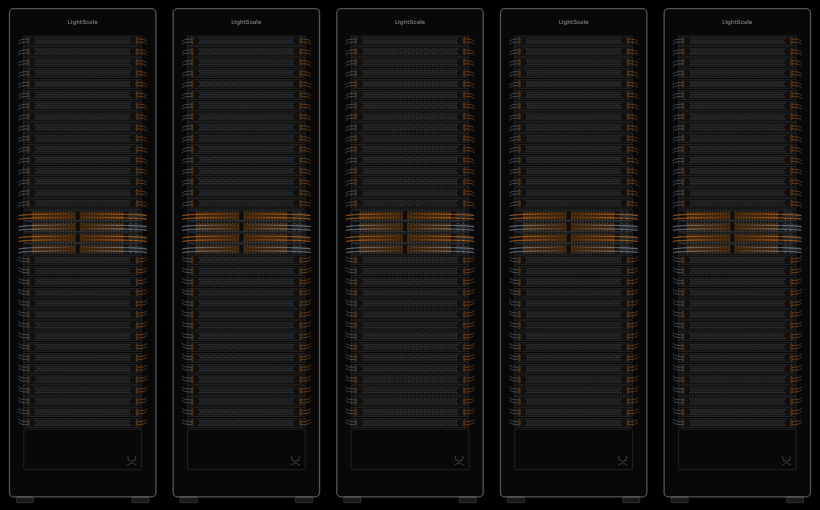
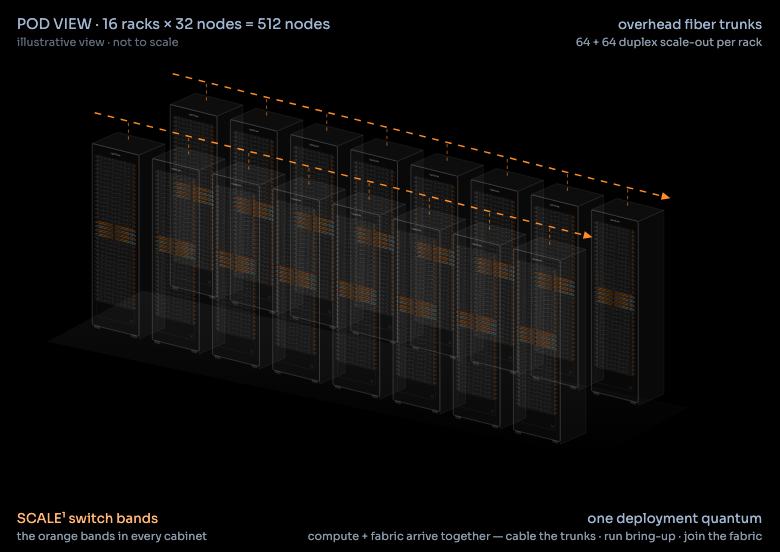
Every cabinet carries thirty-two Photon1 compute nodes and four Scale1 switches across two optical planes, so compute and fabric arrive together — lower it into its slot, cable the overhead trunks, and bring-up walks it into the fabric.
Sixteen racks of thirty-two nodes make a 512-node pod, and the pod’s inter-rack fabric is still glass, end to end.
Deployment quantum
Compute and fabric ship in the same cabinet. A rack lowers into its slot, blind-cables to the overhead trunk, and bring-up walks it into the fabric — one repeatable unit of capacity.
All-glass scale-out
Each rack exposes 64 + 64 duplex ports into overhead fiber trunks that tile the pod into torus, dragonfly, or on-demand fabrics. Between racks, the data path stays optical end to end.
Matched bandwidth
Node-attach and scale-out bandwidth are matched 1 : 1, so the pod has no oversubscription cliff at the rack boundary — and Hyperlane shapes the topology per workload.
The software: LUMA
One programming model across photonic switching and compute
LUMA — the Light Unified Matrix Architecture — is the software layer above LightScale's photonic hardware. A single API spans the Scale1 switching fabric and Photon1 compute: developers write to LUMA, not to individual devices.
Topology, routing, and link assignment are exposed to software and reconfigured at packet cadence. The same code targets every generation, from Scale1 onward, with no per-device rewrite.
Built by researchers at the intersection of photonics and computing
LightScale brings together expertise across photonics, materials, fabrication, large-scale systems, AI infrastructure, and quantum computing, with backgrounds at MIT, Harvard, University of Toronto, Broadcom, NVIDIA, Google, IBM, and Amazon.
Leadership

Kabir Swain
Founder

Manel Baradad
CTO

Tracey Ooi
COO

Jonathan P.
CSO

Sijie Han
Deployment Lead
Advisors

David Garrett
Founding Advisor

Daniel Karl I. Weidele
Advisory Board Member
Also backed by angel investors and advisors who prefer to stay unnamed — for now.
The future of compute needs a new interconnect layer
We're building it: ultrafast, low-energy, programmable photonics, starting with Scale1.